During the August riots in London and around England the police response was particularly closely monitored by news agencies and the public. In Hackney, East London, from where I am writing this piece, the disturbances were at their worst on the second day of disquiet. The police presence rapidly evolved, ominous from the equipment used: the fluorescent jackets of community policing to full riot gear.
With the officers well protected, seemingly a tactic of passive containment was put into motion; officers moving forward during lulls in action of the protestors and making partial retreats when challenged more severely. This, however, allowed those taking part in the disturbances much legroom for opportunistic theft, causing damage to shops and homes alike.
The tactics seemed to quell the will of the mob, perhaps leaving them with spoils and/or proud of making a point to the rest of the nation.
Many of the marginalised in society have very real grievances, yet this argument is not the one we are dealing with here. Why leave property to be taken or damaged in a society that would not normally tolerate such actions in plain view?
In Libya, the Rebels now to be known as the new government have in a Mad Max type manner been re-configuring complex weapons systems, abandoned by the Gaddafi government to suit their less technical expertise. By the time of writing they control most of Libya, a testament to their individual and collective ambition more than technical know-how.
These two instances generate questions of the fundamental principles of possession under a society where the rule of law is not invulnerable.
What are the implications for architecture?
How is a buildings program relevant to or sullied by the society in which it sits, and where do the design team ‘draw a line’ and decide that a building is not in the interests of a wider audience.
Where is the flexibility? A simple example from a friend of mine was a study this year of streetscapes in Soho, Central London, where outdoor seating were always laid within their allotted spaces outside café’s, pubs and restaurants. Yet, sandwich boards, banned in the area on conservation grounds were widely prevalent and dashed across the pavement at many different locations.
With designers often scrambling to be able to build a project it is easy and questionably initially necessary to plumb for projects, which may not have the strictest moral purpose. Do we have the means to contest this; should we care?
Possession is nine tenths of architecture.
Friday, 7 October 2011

Thursday, 19 May 2011
Napoleon's Russian campaign, 1812

Charles Joseph Minard's depiction of losses to Napoleon's army during the campaign
Tuesday, 17 May 2011
Health inequality
‘Inequalities are a matter of life and death, of health and sickness, of well-being and misery. The fact that in England today people in different social circumstances experience avoidable differences in health, well-being and length of life is, quite simply, unfair. Creating a fairer society is fundamental in improving the health of the whole population and ensuring a fairer distribution of good health.
Inequalities in health arise because of inequalities in society - in the conditions in which people are born, grow, live, work and age. So close is the link between particular social and economic features of society and the distribution of health among the population, that the magnitude of health inequalities is a good marker of progress towards creating a fairer society. Taking action to reduce inequalities in health does not require a separate health agenda, but action across the whole of society.’
nicked this from: The Marmot Review, February 2010, Fair Society, Healthy Lives
Friday, 13 May 2011
Open City London Documentary Festival, at City Visions 1910 | 2010 Exhibition: Urban Planning in Berlin, London, Paris and Chicago 1910 and 2010.
As the utopianist debate opened up, the exposed soil pipes overhead swished into action-the shit flowed all-round.
No, kidding, it was good and relevant, enjoyed it.
As the utopianist debate opened up, the exposed soil pipes overhead swished into action-the shit flowed all-round.
No, kidding, it was good and relevant, enjoyed it.
Thursday, 21 April 2011

Saturday, 19 March 2011
Friday, 11 March 2011
Sheep and Ducks
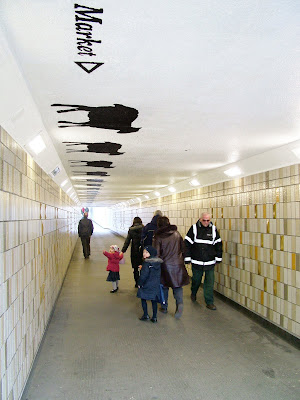
In 1247 English law required that a market were not set up within six and two-thirds miles of any other, this was considered a days sheep drive in distance and meant that competition between markets would be minimised thus allowing thriving markets in each region.
Modern mural type public art is expensive, overlooked and mostly ill-considered. All council's were until recently required by law to include a public art strategy in their planning frameworks.
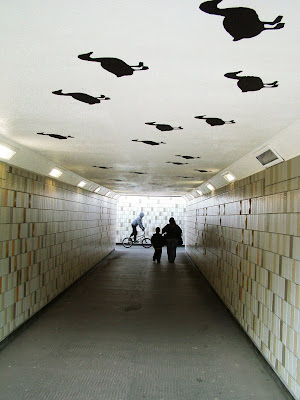
Sheep and Ducks are part of a wider scheme to improve the feeling of safety, orientation and to create a sense of play within a well used subway system within a busy urban context.
the project is a test piece for a wider Masterplan but makes use of existing maintenance budgets, bringing design and negotiation and a sense of place to what was previously just a thoroughfare.
attribute: What-If: projects Ltd
Modern mural type public art is expensive, overlooked and mostly ill-considered. All council's were until recently required by law to include a public art strategy in their planning frameworks.
Sheep and Ducks are part of a wider scheme to improve the feeling of safety, orientation and to create a sense of play within a well used subway system within a busy urban context.
the project is a test piece for a wider Masterplan but makes use of existing maintenance budgets, bringing design and negotiation and a sense of place to what was previously just a thoroughfare.
attribute: What-If: projects Ltd


Subscribe to:
Posts (Atom)